Ontario United Ways Poverty Reduction Strategy Submission
Tanya Noyes • December 5, 2025
Recommendations to the Government of Ontario for the 2025-2030 Poverty Reduction Strategy Renewal
Introduction
Ontario United Ways appreciate the opportunity to contribute to the provincial government’s 2025–2030 Poverty Reduction Strategy consultation.
This is a time for bold leadership. As Ontario faces rising costs and growing economic uncertainty, reducing poverty is not only a social imperative, but also essential to sustaining a strong workforce, supporting local economies and securing the province’s long-term economic growth and prosperity.
While the 2020–2025 Poverty Reduction Strategy made progress in connecting people to employment, rising economic pressures are driving poverty rates higher, especially among groups facing systemic barriers, including Indigenous Peoples, Black and racialized communities, youth, newcomers, and single-parent households. Poverty in Ontario has increased since 2019 and is rising faster than the national average. In 2023, 1.9 million Ontarians lived below the poverty line, unable to afford the necessities for a dignified life. This was up from 1.1 million in 2020.[1] Since 2020, the number of children in poverty in Ontario has more than doubled.[2]
A 2025-2030 Poverty Reduction Strategy – with transparent, measurable goals for reducing poverty and deep poverty, coupled with supporting indicators for housing, food insecurity, access to services, employment stability, equity of outcomes, and more – presents a critical opportunity to address the conditions that both pull people into poverty and keep them there, while strengthening the province’s social and economic infrastructure.
United Ways are ready to partner with the Government of Ontario to advance a community data-informed Poverty Reduction Strategy that delivers measurable results for residents and the province. Our joint submission provides practical, evidence-based recommendations to help people live with dignity, access safe and affordable housing, secure, stable and rewarding work, and receive the supports they need to succeed and thrive.
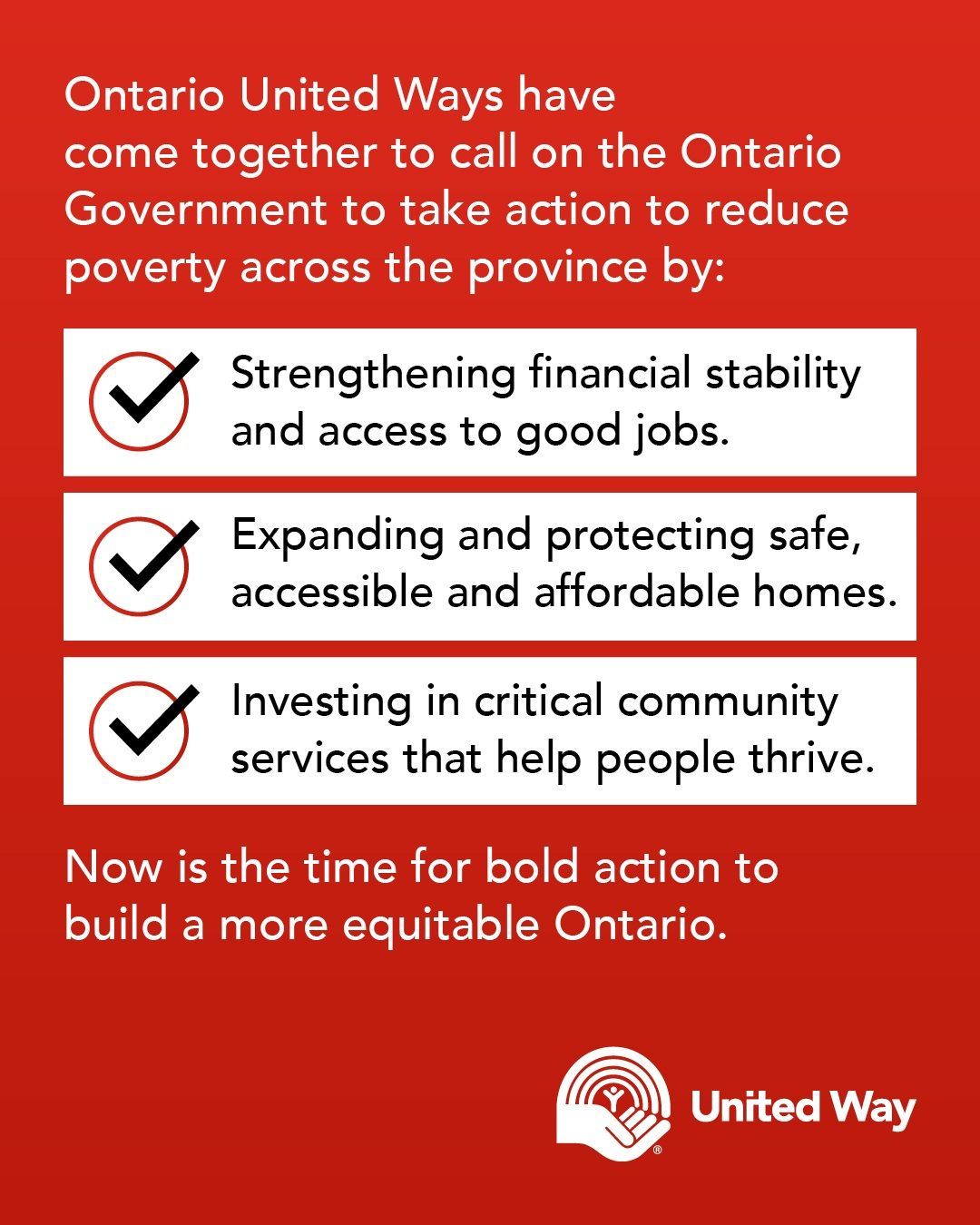
The Government of Ontario can meaningfully alleviate poverty and build the social and economic infrastructure needed for the future prosperity of the province by:
1. Laying the groundwork for financial security, good jobs and strong local economies
2. Getting people housed and keeping them housed by expanding non-market affordable housing, investing in supportive housing, and strengthening renter and tenant protections
3. Ensuring the sustainability of Ontario’s community services infrastructure to continue delivering the critical services that meet the unique needs of communities across the province
1. Laying the groundwork for financial security, good jobs and strong local economies
We commend the government for raising Ontario Disability Support Program (ODSP) rates and committing to tying future increases to the rate of inflation – a practical and common-sense solution. Yet, ODSP rates remain far from adequate to meet basic needs, leaving many recipients in poverty. A single person receives a maximum of $1,408 per month, while the poverty line in Ontario for a single person is approximately $2,221 per month. Ontario Works (OW) rates remain frozen since 2018, with no adjustment for inflation. While OW exit rates have risen, for those that face significant barriers to stable, well-paying employment, the current assistance is not enough. A single recipient on OW receives $733/month, including a $390 shelter allowance – far below the poverty line.[3]
All too often the financial penalties that kick in as people try to transition to stable employment, such as loss of essential income and rental subsidies, act as disincentives, undermining their efforts and keeping them on social assistance. Ontario United Ways and partners know that the equitable neighbourhoods and communities we work towards are only achievable when people are financially stable. Increasing minimum wage, ODSP, and OW rates to livable levels would not only provide immediate relief for lower-income earners, but it would also benefit businesses, boost worker health and well-being, and create a positive multiplier effect in local economies[4].
Precarious work, characterized by low wages, instability and limited access to benefits and support is also rising, leaving many workers without the means to stay healthy, productive, and employed. Efforts to provide equal rights and protections to all workers and identify clear pathways to more stable, better paying jobs is critical to supporting and attracting the workers needed to maintain a strong economy.
In addition to the trades, infrastructure investments can provide pathways to professional, administrative, and technical jobs, and better economic opportunities for residents from historically disenfranchised communities who have not benefited from previous development. Tools such as Community Benefits Agreements (CBAs) can create targeted employment, training, and apprenticeship opportunities, new procurement pathways for local small businesses and suppliers, and improved neighbourhood amenities for residents.
To establish the foundation for all Ontarians to have the means to live in dignity, obtain secure, well-paying jobs, and benefit from economic investments in their communities, we urge government to:
· Raise ODSP and OW rates to livable levels to ensure they meet the basic needs of individuals and families, and index OW rates to inflation annually to ensure they continue to keep pace with the rising cost of living.
· Raise the provincial minimum wage to match the calculated living wage across Ontario to ensure that all workers earn enough to cover their basic needs, improve worker productivity and contribute to local economic growth.
· Address financial barriers and uncertainties that hinder individuals transitioning from social assistance to stable employment through providing smoother transitions off assistance, including temporary continuation of housing and benefit supports and earned income exemptions during early employment, to avoid the ‘poverty trap’ created by clawbacks and sudden loss of supports.
· Ensure Ontarians have access to the knowledge and training to keep up with rapidly changing technologies, such as Artificial Intelligence.
· Remain attentive to deep shifts in the job market, including the displacement and elimination of entry-level and mid-level jobs, and equip job seekers with in-demand skills and training. This is particularly important for both youth and newcomers – two demographics facing increasingly concerning unemployment rates.
· Continue to invest in creating sustainable, stable employment opportunities with a focus on accessible skills training and culturally appropriate wraparound supports for people facing multiple barriers to employment. This includes individuals transitioning from social assistance to sustained employment, Indigenous Peoples, and structurally disadvantaged communities.
· Ensure that any large infrastructure investments coming to Ontario include local economic partnerships that train local community members in the skilled trade jobs that are critically needed to keep the economy going.
2. Getting people housed and keeping them housed by expanding non-market affordable housing, investing in supportive housing, and strengthening renter and tenant protections
A safe, affordable, and accessible home is the first step in ensuring a stable life, foundational for people to access employment, educational opportunities, adequate food, and other support. Yet across Ontario, people face critical barriers to housing, particularly low-income individuals and families. One third of all Ontario households are renters[5], with almost a quarter paying rents that are unaffordable[6]. Housing unaffordability is also associated with poorer physical and mental health outcomes[7] which in addition to the impact on individual well-being, increases pressure on other provincial programs and services.
High rates of core housing need, particularly among renters, single-earner households and Indigenous households are not being met and those experiencing or at risk of homelessness are finding themselves in more desperate circumstances with fewer options. Deeply affordable housing options are also shrinking, pushing more people into homelessness. Every year, billions are spent on the fallout of the housing crisis – on shelters, emergency and hospital visits and other public systems – nearly $1 billion is spent annually on emergency shelters in Ontario.[8]
Regional and demographic variations also create distinct challenges in addressing affordable housing across Ontario. Concerns around affordability continue to be high in the Greater Toronto Area and surrounding areas with Toronto households experiencing core housing need at nearly double the rate of other regions. At the same time, northern, rural, and First Nations communities face particular challenges related to poor repair and higher construction costs.[9] Affordable and supportive housing is also more difficult to access in northern and remote communities, contributing to issues of housing precarity or displacement. With rural homelessness in Ontario increasing at a faster rate than urban homelessness[10], planning and investment in affordable and deeply affordable supply must account for the unique needs and development models suitable to successfully addressing housing need in rural environments.
A strategy designed to alleviate poverty must address housing instability and explore ways to not only get individuals access stable, affordable housing, but to stay housed. To achieve the goal of providing a range of safe, affordable and accessible housing options to protect lower-income Ontarians and strengthen the housing ecosystem, we urge the provincial government to:
· Invest in the community housing sector by providing up-front, low-barrier preconstruction funding and invest in supportive housing by guaranteeing operational funding attached to capital funding.
· Provide more government-owned surplus or under-utilized lands and assets to nonprofit housing and co-operative housing providers at no or low cost to grow deeply affordable and supportive housing options.
· Launch a Government of Ontario non-profit rental acquisition program to preserve existing affordable housing stock to reduce the net loss of housing units while also giving non-profits the opportunity to intensify on those sites to add new housing units.
· Increase interministerial coordination and collaboration by creating infrastructure, such as a provincial housing secretariat function, and supporting small and rural local governments through dedicated programs to build their capacity and expertise in securing funding for housing projects.
· Support low- to moderate-income renter households by preventing evictions and ‘renovictions’ and stabilizing housing so they can live in affordable and secure rental homes.
· Prioritize and address the persistent housing and homelessness challenges faced by Indigenous Peoples through a dedicated strategy, programs and supports developed and implemented by Indigenous leaders and diverse Indigenous communities.
· Identify concrete investments in expanding safe, emergency and transitional housing options designed for women and children fleeing violence and protect the range of affordable housing options that help survivors access and live in secure homes.
· In partnership with municipal governments, prioritize the community housing sector through development incentives and flexible programs that maximize the sector's capacity to compete in the housing market effectively.
3. Ensuring the sustainability of Ontario’s community services infrastructure to continue delivering the critical services and upstream preventative supports that meet the unique needs of communities across the province
The community services sector plays a critical role in providing essential services and supports to Ontarians, especially in the face of increasingly complex and enduring social issues. From mental health and addictions services, affordable, transitional, and supportive housing, employment and skills building, childcare, food security, addressing race-, gender- and faith-based violence, settlement services, and building social connection for seniors and others, community services are critical to our social and economic fabric and collective prosperity. These services and supports play an essential role in preventing homelessness, unemployment, and mental health and other challenges through emergency or urgent needs funding programs. The nonprofit sector in Ontario also contributes 7.9% to the province’s GDP, constituting $65.4 billion in economic impact.
Funding deficits, an unprecedented need for services, significant challenges in recruiting and retaining staff, and a toll on the mental health of frontline workers themselves are eroding the stability and sustainability of Ontario’s vital community services infrastructure. Many workers in the sector – predominantly female and racialized – are precariously employed, receiving lower wages than their private and public sector counterparts. Volunteerism and charitable giving are also steadily declining[11] [12], putting further strain on the sector as it fills the gaps to respond to a growing mental health, addictions, and housing crisis.
There is an urgent need to collaboratively identify public policy solutions to mitigate current challenges and establish a sustainable model that will effectively support the sector many Ontarians increasingly depend on today and into in the future.
United Ways urge government to:
· Transition to stable, flexible, long-term operational funding, adjusted for inflation, that reflects the full cost of delivering services and programs, allows for competitive wages, reduces administrative burden, and can be adjusted to respond to changing community needs.
· Support the development of a sector-wide labour force strategy and workforce development plan that will attract, retain and train workers while reducing precarious work conditions and delivering wage parity.
· Invest in new and innovative approaches to funding and service delivery in rural and remote communities, including those that address the housing and mental health and addictions crises and respond to the unique needs of equity-deserving groups.
· Partner with the sector to explore possible strategies to support the recovery of volunteerism and charitable giving in the province.
· Establish a permanent home within government for the social services sector to streamline policy and program coordination across Ministries and sector partners.
Conclusion
Ontario United Ways appreciate the opportunity to contribute to the development of the 2025–2030 Poverty Reduction Strategy. With deep reach into communities across Ontario, United Ways stand ready to collaborate with government to drive bold, evidence-based solutions that address poverty’s root causes and build a more equitable and prosperous Ontario for all. Now is the time to consolidate our efforts, share experience and work towards a Poverty Reduction Strategy that builds the foundation for a better future for each an every Ontarian.
Endorsing United Ways
United Way Bruce Grey
United Way Centraide North East Ontario
United Way Centraide Simcoe Muskoka
United Way/Centraide Stormont-Dundas & Glengarry
United Way Centraide Windsor-Essex
Chatham-Kent
United Way Haliburton Kawartha Lakes
United way Durham Region
United Way East Ontario
United Way Greater Toronto
United Way Guelph Wellington Dufferin
United Way of Haldimand and Norfolk
United Way Halton & Hamilton
United Way Hastings & Prince Edward
United Way Kingston, Frontenac, Lennox & Addington
United Way Leeds & Grenville
United Way London Middlesex
United Way Oxford
United Way Niagara
United Way Northumberland
United Way Perth Huron
United Way Peterborough & District
United Way Sault Ste. Marie & Algoma District
United Way of Thunder Bay
United Way Waterloo Region Communities
[1] Statistics Canada (2025, November 7).
Table 11-10-0135-01 Low income statistics by age, sex and economic family type
[2] Ibid.
1 Gaetz S, Dej E, Richter T, et al. (2016). The state of homelessness in Canada 2016. Toronto: Canadian Observatory on Homelessness Press.
[4] Barford, A., Gilbert, R., Beales, A., Zorila, M., & Nelson, J (2022). The case for living wages: How paying living wages improves business performance and tackles poverty. Business Fights Poverty, University of Cambridge Institute for Sustainability Leadership & Shift.
[5] Statistics Canada (2022, July 21). Table 46-10-0059-01 Housing suitability and dwelling condition, by tenure including social and affordable housing.
6 Statistics Canada (2022, July 21). Table 46-10-0065-01 Core housing need, by tenure including first-time homebuyer and social and affordable housing status.
[7] Leon, S., & Iveniuk, J. (2021). Widening inequities: Long-term housing affordability in the Toronto Census Metropolitan Area 1991-2016.
[8] Gaetz S, Dej E, Richter T, et al. (2016). The state of homelessness in Canada 2016. Toronto: Canadian Observatory on Homelessness Press.
[9] Association of Municipalities Ontario (2022). A Blueprint for Action: An Integrated Approach to Address the
Ontario Housing Crisis.
[10] Ibid.
[11] Ibid.
[12] Canada Helps (2022). The Giving Report 2022.